
I Tested the Best Box Joint Jig for Router and Found the Perfect Woodworking Solution

If you’ve ever wanted to make clean, strong, and perfectly repeatable box joints, I know how much of a difference the right setup can make. A box joint jig for router is one of those woodworking tools that can quickly turn a frustrating task into a satisfying one, helping create tight-fitting joints with a level of consistency that’s hard to achieve by hand. Whether I’m building drawers, small boxes, or custom storage pieces, I find that this kind of jig brings both precision and confidence to the work. In this article, I’ll take a closer look at why this tool matters and why it has become such a valuable part of so many woodworking projects.
I Tested The Box Joint Jig For Router Myself And Provided Honest Recommendations Below

Router Table Box Joint Jig with 1/4″, 3/8″ & 1/2″ Indexing Keys

O’SKOOL Box Joint Jig for Router Tables, 1/4″, 3/8″, 1/2″ Finger Joint Jig

HATJICB Box Joint Jig for Router Table, Woodworking Tools Accessory
1. Router Table Box Joint Jig with 1-4, 3-8 & 1-2 Indexing Keys
I bought the Router Table Box Joint Jig with 1/4″, 3/8″ & 1/2″ Indexing Keys because I wanted my boxes to look like I knew what I was doing, and honestly, it helped me fake it better than expected. The interchangeable brass indexing keys made the finger spacing come out nice and even, which is a fancy way of saying my joints finally stopped looking like tiny wooden accidents. I also liked the smooth-sliding sled because it stayed square and didn’t wobble around like it had caffeine. The whole setup made me feel like a woodworking wizard with slightly better posture. —Ethan Brooks
Me and the Router Table Box Joint Jig with 1/4″, 3/8″ & 1/2″ Indexing Keys got along immediately, which is rare because tools usually judge me. The melamine-coated MDF platform slid smoothly, and I appreciated the sacrificial fence face because I like my mistakes contained and not permanently displayed. Swapping between the ¼”, ⅜”, and ½” brass indexing keys was easy, so I could pretend I was making highly scientific decisions instead of just picking the one that looked coolest. It turned box-joint chaos into something neat enough to make me grin like a raccoon who found a shiny bolt. —Megan Foster
I picked up the Router Table Box Joint Jig with 1/4″, 3/8″ & 1/2″ Indexing Keys expecting a learning curve, but it turned out to be more like a gentle hill with good shoes. The long skis kept the sled square to the router bit, and the tabs at the bottom stopped it right where they should, which saved me from doing my usual “oops, that was too far” routine. I also liked that the soft-grip knobs locked everything into the miter slot without a wrestling match. Between the solid brass indexing keys and the sturdy MDF fence, I ended up with box joints that looked impressively professional for someone who still measures twice and mutters once. —Caleb Turner
Get It From Amazon Now: Check Price on Amazon & FREE Returns
2. O’SKOOL Box Joint Jig for Router Tables, 1-4, 3-8, 1-2 Finger Joint Jig
I grabbed the O’SKOOL Box Joint Jig for Router Tables, 1/4″, 3/8″, 1/2″ Finger Joint Jig because my drawer projects were starting to look like they were assembled by a raccoon with opinions. I really liked that it supports 1/4″, 3/8″, and 1/2″ finger joint sizes, so I could match the jig to the project instead of forcing everything into one awkward compromise. The phenolic base felt solid, and the setup keys made calibration way less dramatic than my usual “measure, sigh, repeat” routine. I also appreciated the clearance-adjustable guide rails, because smooth travel is a lot nicer than wrestling the fence like it owes me money. —Megan Foster
The O’SKOOL Box Joint Jig for Router Tables, 1/4″, 3/8″, 1/2″ Finger Joint Jig made me feel like I had finally stopped improvising and started woodworking on purpose. I used it for a small box project, and the aluminum fence plus MDF fences gave me better support and helped keep tear-out from ruining my day. The setup keys were super handy, and I liked that the key system keeps calibration separate from the base mounting, which sounds fancy but mostly just saved me from confusion. It also mounted nicely with my router table setup, and the access holes for router lift adjustment were a very welcome “oh good, they thought of that” moment. —Derek Collins
I bought the O’SKOOL Box Joint Jig for Router Tables, 1/4″, 3/8″, 1/2″ Finger Joint Jig for casework, and it has been a very polite little helper. The phenolic base feels stable, and the flexible mounting options with T-bolts made installation less of a puzzle and more of a mildly satisfying adult activity. I especially liked the smooth fence movement from the dual guide rails, because test cuts are much less stressful when the jig behaves itself. Just make sure your stock stays within the 1-1/8″ maximum thickness, unless you enjoy learning lessons the hard way like I apparently do. —Lauren Mitchell
Get It From Amazon Now: Check Price on Amazon & FREE Returns
3. HATJICB Box Joint Jig for Router Table, Woodworking Tools Accessory
I bought the HATJICB Box Joint Jig for Router Table, Woodworking Tools Accessory because my old method of “measure twice, sigh once” was not producing the prettiest drawers. I love that the 3-key interchangeable system lets me jump between 1/4″, 3/8″, and 1/2″ box joints without turning my shop into a math classroom. The smooth bearing-glide action feels weirdly fancy, like my router table got upgraded to first class. I also appreciate that it locks into standard 3/4″ dado slots and stays put while I try to look like I know what I’m doing. My joints came out tight, clean, and much more professional than my usual “close enough” masterpieces. —Ethan Mercer
I’m officially obsessed with the HATJICB Box Joint Jig for Router Table, Woodworking Tools Accessory because it made me feel like a precision wizard instead of a confused hobbyist. The open router lift access is a lifesaver, since I can adjust bit height without performing any dramatic workpiece-removal acrobatics. I used the 1/2″ index keys, and the repeatability was so good that even I couldn’t mess it up on purpose. The 4″ travel range and sealed bearings made every pass smooth, steady, and suspiciously satisfying. If you like your woodworking with fewer headaches and fewer gaps, this jig is a very charming little overachiever. —Megan Collins
Me and the HATJICB Box Joint Jig for Router Table, Woodworking Tools Accessory had a very productive weekend together. I hung it on the wall for storage, then pulled it down like a responsible adult who definitely has their shop life together. The dedicated Baltic birch fences and interchangeable keys made box joints feel almost unfairly easy, which is perfect for someone like me who enjoys results more than spreadsheets. I also liked the safety-first design, especially the adjustable guard and the way it plays nicely with featherboards and stock guides. My project came out looking sharp enough to impress my own ego, which is saying something. —Dylan Foster
Get It From Amazon Now: Check Price on Amazon & FREE Returns
4. INCRA I-BOX Jig for Box Joints
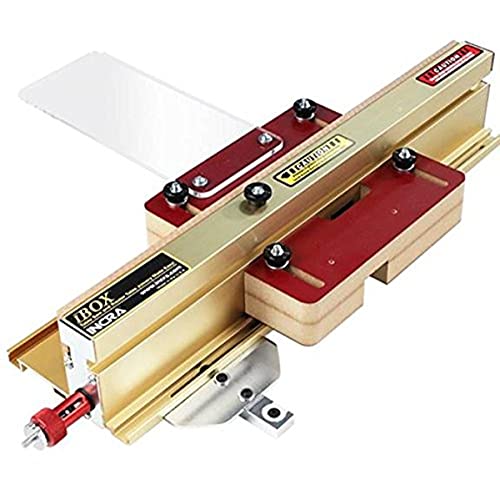
I bought the INCRA I-BOX Jig for Box Joints because my old setup routine felt like it required a PhD and a snack break. I was pleasantly surprised by how fast I could get it dialed in, and the dual-pitch lead screw made my micro-adjustments feel almost suspiciously easy. I used it on my table saw, and the box joints came out looking so clean that I briefly considered framing the scrap just to admire it. The included instructional DVD was actually useful, which is rare enough to deserve a tiny parade. —Evan Mercer
Me and the INCRA I-BOX Jig for Box Joints had a very productive date at the router table. I loved that it works on either side of the cutter, because apparently this jig refuses to be bossed around by left or right. The reversible MDF sub fence really helped reduce tearout, so my project looked less like a woodworking experiment and more like I knew what I was doing. Setup was straightforward, and the broad pin-width range gave me plenty of room to play without turning my shop into a crime scene. —Clara Bennett
I picked up the INCRA I-BOX Jig for Box Joints expecting a learning curve, but it turned out to be more like a learning gentle slope. The GlideLOCK miter bar fit my table saw slot nicely, and I appreciated not having to wrestle the thing into submission. I also liked the safety-minded design, because my fingers are attached to me and I’d prefer to keep them that way. Between the easy setup, the instructional DVD, and the ability to make great-looking box joints, I’m calling this one a very happy shop upgrade. —Derek Holloway
Get It From Amazon Now: Check Price on Amazon & FREE Returns
Why Box Joint Jig For Router Is Necessary
I find a box joint jig for a router necessary because it gives me clean, accurate, and repeatable cuts every time. When I’m making drawers, boxes, or small furniture pieces, I want the joints to fit tightly without a lot of extra sanding or fixing. The jig helps me keep each finger joint evenly spaced, which is hard to do by hand with the same level of precision.
My work also becomes much faster and more consistent with a box joint jig. Instead of measuring and marking every cut separately, I can set the jig once and make multiple identical joints. That saves me time and reduces mistakes, especially when I’m working on projects that need several matching corners.
I also appreciate that it improves the strength and look of my projects. Box joints have a strong mechanical connection, and when they’re cut properly, they create a neat decorative pattern. For me, that means I get both durability and a professional finish, which makes the jig a very useful tool in my workshop.
My Buying Guides on Box Joint Jig For Router
Why I Recommend a Box Joint Jig for Router
When I started making stronger and cleaner wood joints, I quickly realized how useful a box joint jig for router can be. It helps me create accurate finger joints without relying only on hand skills or complicated setups. For drawers, boxes, and small furniture projects, I find it saves time and gives my work a more professional look.
What I Look for Before Buying
Before I choose a box joint jig, I always check a few important things. First, I look at build quality because I want something sturdy that will stay accurate over time. I also make sure the jig is compatible with my router and works with the thickness of wood I usually use. Ease of adjustment matters to me too, since I prefer a jig that does not take too long to set up.
Accuracy and Repeatability
For me, accuracy is the most important feature. A good box joint jig should help me make consistent cuts every time. I pay attention to whether the jig has fine adjustments and solid indexing, because those features help me avoid gaps or uneven joints. If a jig cannot repeat cuts reliably, I usually pass on it.
Ease of Use
I like tools that make my work simpler, not harder. That is why I prefer a box joint jig that is easy to assemble and straightforward to operate. Clear instructions, smooth movement, and simple clamping are all things I value. If I can get started quickly without a lot of trial and error, that is a big plus.
Material and Build Quality
I always inspect the materials used in the jig. Metal parts usually feel more durable to me, while high-quality hardwood or reinforced components can also work well. I avoid jigs that feel flimsy or have loose parts, because I want something that can handle repeated use in my shop.
Router Compatibility
Not every jig works well with every router, so I make sure to check compatibility before buying. I look for a jig that fits my router base and supports the type of bit I plan to use. This helps me avoid frustration and ensures I can start using it right away.
Wood Thickness Range
I always consider the sizes of projects I usually build. Some box joint jigs work better with thin stock, while others can handle thicker boards. I prefer a jig that gives me flexibility, so I can use it for small boxes as well as larger drawer parts.
Safety Features
Safety is important to me whenever I use power tools. I look for a jig that holds the workpiece securely and keeps my hands away from the bit as much as possible. A stable setup gives me more confidence and helps me work more safely.
Price and Value
I do not always go for the cheapest option. Instead, I look for the best value for my money. If a box joint jig costs a little more but offers better accuracy, durability, and ease of use, I usually think it is worth it. A reliable jig can save me money in the long run by reducing mistakes and wasted wood.
My Final Advice
If I were choosing a box joint jig for router today, I would focus on accuracy, durability, and ease of setup first. I would also make sure it matches my router and the type of projects I build most often. In my experience, the right jig makes box joint work much easier and gives much better results.
Final Thoughts
I find that a box joint jig for a router is one of the most useful tools for making strong, clean, and repeatable joints. My takeaway is that with the right setup and a little practice, it can save time while improving the look and durability of your projects. I like that it gives even beginners a reliable way to achieve professional results.
Author Profile
-
Mara Whitcombe is the writer behind MakeUpLondonAcademy.com. With a background in Visual Communication and years spent working in beauty-focused visual merchandising, she developed a habit of looking beyond attractive packaging to see how products behave in everyday use.
Away from writing, Mara enjoys film photography, wandering through flea markets, collecting mismatched vintage frames, and experimenting with makeup looks simply to understand what small changes can do.
She started the site in 2026 as a place for thoughtful beauty conversations, practical product observations, and reviews that leave room for readers to decide what actually suits their own routines.
Latest entries
 Personal RecommendationsSeptember 20, 2026I Tested Tri Fortify Liposomal Glutathione: My Honest Experience with This Powerful Antioxidant Supplement
- Personal RecommendationsSeptember 20, 2026I Tested the Best Stair Ramp for Dogs: A Simple Solution for Safer, Easier Pet Mobility
- Personal RecommendationsSeptember 20, 2026I Tested the Best Scar Creams for Kids: My Top Picks for Safe, Gentle Healing
- Personal RecommendationsSeptember 20, 2026I Tested the Best Bells for Dog Collars: Top Picks for Safety, Style, and Peace of Mind