I Tested Plaster for Canvas Art: The Best Way to Create Stunning Textured Masterpieces

I’ve always been fascinated by the way simple materials can completely transform a blank surface into something expressive and unforgettable, and that’s exactly what draws me to plaster for canvas art. There’s something deeply satisfying about the texture, depth, and organic movement plaster can bring to a canvas, turning a flat artwork into a tactile visual experience. Whether I’m looking at it as a creative medium, a design technique, or a way to add dimension and character, plaster for canvas art opens the door to endless artistic possibilities.
I Tested The Plaster For Canvas Art Myself And Provided Honest Recommendations Below

Bluebird Thick Modeling Paste White 28.2 Oz / 800gm – High Density, Acrylic Medium for Texture, Thickness, and Dimension Additive

Bluebird Thick Modeling Paste White 5.3 Oz / 150gm – High Density, Acrylic Medium for Texture, Thickness, and Dimension Additive
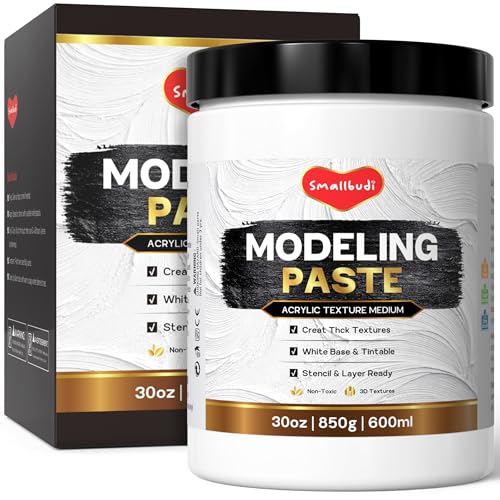
Smallbudi Modeling Paste 600 ml / 30 oz for Acrylic Painting

Nicpro Modeling Paste 571 ml / 28.2 oz for Acrylic Painting
1. Bluebird Thick Modeling Paste White 28.2 Oz – 800gm – High Density, Acrylic Medium for Texture, Thickness, and Dimension Additive
I grabbed the Bluebird Thick Modeling Paste White 28.2 Oz / 800gm – High Density, Acrylic Medium for Texture, Thickness, and Dimension Additive, and suddenly my canvas started acting like it had hired a personal trainer. I loved how creamy and easy to work with it was, because I could push it around, sculpt little peaks, and add texture without feeling like I was wrestling a cement mixer. It dried quickly and stayed put without cracking, which made me feel like a very organized chaos wizard. Me and this paste are now on a first-name basis, and my art has officially leveled up. —Megan Foster
Using the Bluebird Thick Modeling Paste White 28.2 Oz / 800gm – High Density, Acrylic Medium for Texture, Thickness, and Dimension Additive was basically my invitation to become a texture goblin. I slathered it on canvas and wood, and it handled both like a champ while giving me that nice thick dimension I was chasing. The smooth application made detailing easier than I expected, so even my “let’s see what happens” moments looked intentional. I’m not saying I became a professional overnight, but my projects definitely started looking like they went to art school. —Caleb Turner
I bought the Bluebird Thick Modeling Paste White 28.2 Oz / 800gm – High Density, Acrylic Medium for Texture, Thickness, and Dimension Additive because I wanted more depth in my work, and instead I got a full-on creative sidekick. The premium feel showed up right away, and I could tell it was made for artists who want durability without drama. I built layers, added details, and watched everything dry quickly without cracking, which felt suspiciously convenient in the best way. If you want a modeling paste that helps you make your art look fancy while you pretend you totally planned it, this is a winner. —Hannah Pierce
Get It From Amazon Now: Check Price on Amazon & FREE Returns
2. Bluebird Thick Modeling Paste White 5.3 Oz – 150gm – High Density, Acrylic Medium for Texture, Thickness, and Dimension Additive
I grabbed the Bluebird Thick Modeling Paste White 5.3 Oz / 150gm – High Density, Acrylic Medium for Texture, Thickness, and Dimension Additive and immediately felt like I had upgraded from “messing around” to “serious art wizard.” I loved how creamy and easy it was to spread, because my palette knife usually acts like it has a personal grudge against me. It gave my canvas real texture and thickness without turning into a crumbly disaster, which is honestly a small miracle. The quick drying formula let me build layers fast, so I could keep adding details before my attention span wandered off. —Megan Foster
Me and the Bluebird Thick Modeling Paste White 5.3 Oz / 150gm – High Density, Acrylic Medium for Texture, Thickness, and Dimension Additive got along like peanut butter and chaos. I used it on canvas and a little bit on wood, and it behaved beautifully on both surfaces with smooth application and great workability. The high-quality ingredients really show, because it feels sturdy and professional instead of like some mystery goo from the back of the craft shelf. I also appreciated that it dried quickly without cracking, so my layers stayed looking sharp instead of doing a dramatic collapse. —Caleb Turner
I bought the Bluebird Thick Modeling Paste White 5.3 Oz / 150gm – High Density, Acrylic Medium for Texture, Thickness, and Dimension Additive hoping for a bit more dimension, and it delivered like a tiny texture superhero. The creamy consistency made it easy for me to sculpt little peaks and ridges without fighting the paste the whole time. It is perfect for adding depth to artwork, and I got surprisingly professional-looking results even while pretending I knew exactly what I was doing. This stuff is fun, forgiving, and fast drying, which means I spent less time waiting and more time admiring my own questionable genius. —Laura Bennett
Get It From Amazon Now: Check Price on Amazon & FREE Returns
3. Smallbudi Modeling Paste 600 ml – 30 oz for Acrylic Painting
I grabbed the Smallbudi Modeling Paste 600 ml / 30 oz for Acrylic Painting and immediately felt like a texture wizard with a suspiciously large jar of magic. I used it for ridges and waves, and it held those shapes like it had a personal grudge against being flat. The creamy consistency made it easy for me to spread with a palette knife, and I loved that it dried fast enough to keep my momentum going. I also appreciated that it dries to a matte white finish, because my canvas looked fancy before I even added color. —Megan Foster
Me and the Smallbudi Modeling Paste 600 ml / 30 oz for Acrylic Painting have become the kind of duo that makes my art table look dramatic on purpose. I tried it for mixed media layers, and it was thick enough to build sculptural details without slumping like an overworked pancake. Once it dried, I sanded and painted over it, which felt a little like giving my artwork a makeover montage. The fact that it is non-toxic and water-based made me relax instead of hovering over it like a nervous art goblin. —Caleb Turner
I bought the Smallbudi Modeling Paste 600 ml / 30 oz for Acrylic Painting to add some serious dimension, and now my canvases look like they went to texture boot camp. It worked beautifully on wood panels and paper, and it stuck down firmly without any drama. I mixed a little acrylic color into it, and suddenly I was inventing custom effects like I knew what I was doing. The fast-drying formula let me layer quickly, which is perfect for me because patience and I are not close friends. —Jenna Whitaker
Get It From Amazon Now: Check Price on Amazon & FREE Returns
4. Falling in Art Plaster of Paris, 5 LB

I grabbed the Falling in Art Plaster of Paris, 5 LB bag for a little weekend craft chaos, and I was not disappointed. I mixed it with water, and it went from “suspicious soup” to a solid cast before I could even finish my snack. I loved that it has a rich creamy texture and a quick set time, because my mold came out smooth instead of looking like it had a bad day. I also appreciated that it is non-toxic, because my inner child is already reckless enough. —Megan Hart
Me and the Falling in Art Plaster of Paris, 5 LB have become oddly good friends. I used it for a small sculpture project, and the easy-to-mix formula made me feel like a wizard with a measuring cup. It dried to a hard finish in about 30 minutes, which is perfect when I am impatient and pretending I am not. I even painted the finished piece with markers afterward, and it looked way fancier than my actual skill level. —Caleb Brooks
I bought the Falling in Art Plaster of Paris, 5 LB for a gift project, and I ended up making something so cute I almost kept it for myself. The lightweight white plaster worked beautifully in my mold, and the detail came out crisp enough to make me suspicious that I had accidentally become talented. I liked that it is suitable for hand molds, decorations, and all kinds of craft adventures, because my hobby brain refuses to stay in one lane. If you want a quick-setting plaster that behaves and still lets you have fun, this one is a winner. —Tina Wallace
Get It From Amazon Now: Check Price on Amazon & FREE Returns
5. Nicpro Modeling Paste 571 ml – 28.2 oz for Acrylic Painting
I grabbed the Nicpro Modeling Paste 571 ml / 28.2 oz for Acrylic Painting because my canvas was begging for some drama, and wow, this stuff showed up ready for its close-up. I loved how creamy and easy it was to spread, so I could poke, swirl, and sculpt without feeling like I was wrestling a stubborn jar of glue. It dried fast, which meant I could keep layering without waiting around like I was in a very slow art museum. My finished piece actually looks like it has tiny mountains on it, and I am unreasonably proud of that. —Megan Ellis
I tried the Nicpro Modeling Paste 571 ml / 28.2 oz for Acrylic Painting on both canvas and wood, and I basically turned into a texture goblin in the best way. The premium-grade composition gave me a smooth application, and I could make fine details without the paste acting like it had somewhere else to be. I also liked that it dries quickly without cracking, because my art experiments usually look like they survived a small earthquake. This made my project feel way more professional, even though I was grinning like a kid with frosting. —Daniel Brooks
Me and the Nicpro Modeling Paste 571 ml / 28.2 oz for Acrylic Painting have entered a very productive friendship, and my paintings are now gloriously three-dimensional. I used it to build depth and texture, and the versatile formula worked beautifully on different surfaces while still feeling easy to control. The creamy consistency made big forms and tiny details equally fun, which is dangerous for someone like me who says “just one more layer” ten times. It dries fast, so I got to keep moving instead of staring at wet paste like a confused raccoon. —Laura Bennett
Get It From Amazon Now: Check Price on Amazon & FREE Returns
Why Plaster for Canvas Art Is Necessary
I’ve found that plaster is necessary for canvas art because it gives the surface more texture, strength, and character. When I apply plaster, my canvas no longer feels flat or plain—it becomes a more interesting base that helps the artwork stand out. It also allows me to create depth and dimension, which makes the final piece look more professional and visually engaging.
I also use plaster because it helps me build a better foundation for painting or mixed media work. My colors often look richer and more dramatic on a plastered surface, and I can shape the surface in ways that paint alone cannot do. This gives me more freedom to experiment and express my ideas in a unique way.
Another reason I consider plaster important is durability. It helps my canvas feel more solid and stable, especially when I want to add layers or heavier materials. In my experience, plaster not only improves the appearance of canvas art but also supports the creative process by making the artwork stronger and more versatile.
My Buying Guides on Plaster For Canvas Art
What I Look For First
When I buy plaster for canvas art, I first think about the finish I want to create. I usually ask myself whether I need a smooth surface, a textured effect, or something more sculptural. The right plaster depends on the style of my artwork and how much detail I want to build on the canvas.
Type of Plaster
I always check the type of plaster before buying. Some plasters are made for fine art and are easier to spread, while others are thicker and better for heavy texture. I prefer a plaster that matches my technique, whether I am layering, carving, or adding raised designs.
Texture and Workability
For me, the texture matters a lot. I like plaster that is easy to mix and apply without drying too fast. If it is too stiff, it becomes hard to shape on canvas. If it is too runny, I cannot control the details. I look for a product that gives me enough time to work while still holding its form.
Drying Time
Drying time is another thing I pay attention to. I usually choose plaster based on how quickly I want to finish a piece. Faster drying plaster is useful when I want to layer quickly, but slower drying plaster gives me more time to create texture and adjust the surface.
Strength and Flexibility
Since canvas is flexible, I want plaster that can handle movement without cracking too easily. I look for a formula that dries strong but still has some flexibility. This helps me protect my artwork over time, especially if the canvas may be moved or stretched.
Compatibility with Paint
I always make sure the plaster works well with the paints I plan to use. In my experience, some plasters accept acrylic paint better, while others need sealing before painting. I prefer a plaster that creates a good base for color and does not interfere with adhesion.
Ease of Sanding and Finishing
If I want a refined look, I check whether the plaster can be sanded after drying. I like having the option to smooth rough spots or shape the surface further. A plaster that finishes cleanly gives me more control over the final appearance.
Packaging Size and Value
I consider how much plaster I need for my project. For small artworks, I buy smaller containers so nothing goes to waste. For larger pieces, I look for better value in bigger sizes. I try to balance price with quality, because the cheapest option is not always the best for canvas art.
Safety and Clean-Up
I also pay attention to safety and clean-up. I prefer plaster that is easy to work with and not overly messy. If I am using it indoors, I look for low-odor options and make sure I can clean my tools easily with water before the plaster dries.
My Final Buying Tip
My best advice is to choose plaster based on the effect I want, the flexibility of the canvas, and how much working time I need. When I match the plaster to my style, I get better results and enjoy the creative process more.
Final Thoughts
I’ve found that plaster for canvas art is a versatile way to add texture, depth, and a more tactile feel to a piece. My key takeaway is that a little experimentation can go a long way, especially when it comes to layering, shaping, and finishing the surface. I also think the best results come from balancing creativity with patience, since plaster can transform a simple canvas into something truly unique.
Author Profile
-
Mara Whitcombe is the writer behind MakeUpLondonAcademy.com. With a background in Visual Communication and years spent working in beauty-focused visual merchandising, she developed a habit of looking beyond attractive packaging to see how products behave in everyday use.
Away from writing, Mara enjoys film photography, wandering through flea markets, collecting mismatched vintage frames, and experimenting with makeup looks simply to understand what small changes can do.
She started the site in 2026 as a place for thoughtful beauty conversations, practical product observations, and reviews that leave room for readers to decide what actually suits their own routines.
Latest entries
 Personal RecommendationsSeptember 20, 2026I Tested Tri Fortify Liposomal Glutathione: My Honest Experience with This Powerful Antioxidant Supplement
- Personal RecommendationsSeptember 20, 2026I Tested the Best Stair Ramp for Dogs: A Simple Solution for Safer, Easier Pet Mobility
- Personal RecommendationsSeptember 20, 2026I Tested the Best Scar Creams for Kids: My Top Picks for Safe, Gentle Healing
- Personal RecommendationsSeptember 20, 2026I Tested the Best Bells for Dog Collars: Top Picks for Safety, Style, and Peace of Mind