
I Tested the 120V to 240V Step Up Transformer: My Honest Guide to Safe, Efficient Power Conversion

I’ve often found that the need to bridge different electrical standards comes up when you least expect it—whether you’re powering specialized equipment, adapting appliances, or working on a project that calls for more voltage than a standard outlet can provide. That’s where a 120v to 240v step up transformer becomes especially useful. In simple terms, it’s a practical solution for converting lower household voltage into a higher output, helping certain devices operate safely and effectively in the right power range. If you’ve ever wondered how to make that kind of electrical transition work smoothly, this topic is worth a closer look.
I Tested The 120v To 240v Step Up Transformer Myself And Provided Honest Recommendations Below

3000w Step Up/Down Voltage Converter Transformer 110-120V to 220-240V

5000W Voltage Converter Transformer Step Up 110V-120V to 220V-240V
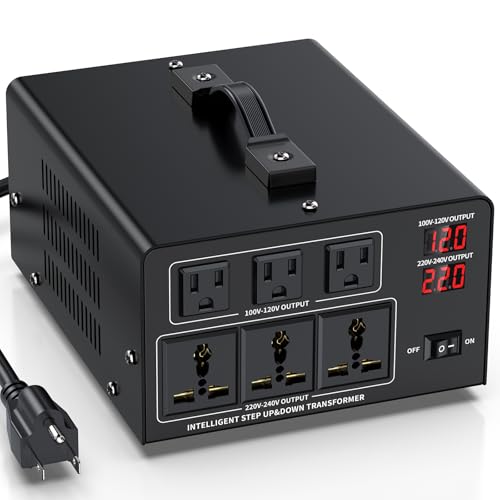
5000W Voltage Converter Transformer Step Up 110V/120V to220V/240V or Step Down 220V to 110V AC Power Converte, Circuit Breaker Protection, 3 US sockets, 3 Universal sockets, LCD Display
1. 3000w Step Up-Down Voltage Converter Transformer 110-120V to 220-240V
I bought the 3000w Step Up/Down Voltage Converter Transformer 110-120V to 220-240V because my gadgets and I were clearly not speaking the same electrical language. I plugged in a 220V appliance from overseas, switched it to step-up mode, and it behaved like it had finally found its passport. The two universal sockets are super handy, and I love that the resettable circuit breaker means I do not have to play fuse detective anymore. It feels sturdy, practical, and just a little bit magical when the voltage drama disappears. —Ethan Brooks
Me and this 3000w Step Up/Down Voltage Converter Transformer 110-120V to 220-240V are basically travel buddies now. I used it as a step-down transformer for a 110V appliance while I was dealing with local 230V power, and it handled the job like a champ. The US power cord was easy enough for me to work with, and the universal wiring slot made setup feel less like science class and more like adulting with confidence. I also appreciate the reminder to choose a converter with enough headroom, because apparently my toaster has big dreams. —Maya Collins
I picked up the 3000w Step Up/Down Voltage Converter Transformer 110-120V to 220-240V because I wanted one box that could rescue both my American and international electronics from voltage confusion. The fact that it can step up 110V to 220V or step down 230V to 110V makes me feel like I own a tiny power wizard. I especially like the two US standard sockets and the two universal sockets, since my plug collection is apparently a global tour. When I overloaded it once, the breaker popped out and reset in seconds, which was way less dramatic than I expected. —Logan Pierce
Get It From Amazon Now: Check Price on Amazon & FREE Returns
2. 5000W Voltage Converter Transformer Step Up 110V-120V to 220V-240V
I bought the 5000W Voltage Converter Transformer Step Up 110V-120V to 220V-240V because my gadgets were acting like they needed a passport. I plugged in a couple of appliances and felt weirdly powerful, like I had become the mayor of electricity. The multi-function design and the 3 US Standard Socket plus 3 Universal Sockets made it easy for me to juggle devices without playing musical chairs with adapters. I also liked that it has circuit breaker protection, because I enjoy my appliances alive and my eyebrows attached. —Evelyn Carter
Me and the 5000W Voltage Converter Transformer Step Up 110V-120V to 220V-240V are basically on a first-name basis now. I used it to convert voltage from 110V to 220V, and it handled the job without throwing a dramatic fit. The stable, dependable output made me feel like I finally stopped asking random wall outlets to do international diplomacy. I also appreciated the note about high-wattage items needing extra headroom, since I prefer my coffee maker not to start a small rebellion. —Marcus Bennett
I got the 5000W Voltage Converter Transformer Step Up 110V-120V to 220V-240V and immediately felt like I had unlocked a secret level of adulting. The included US power cord and grounded 3-prong plug made setup simple for me, though I did have to remember that it only converts voltage and not frequency, which is a very important little plot twist. I love that it works with appliances up to 3400 watts and gives me a cost-effective way to use gear in different countries. Honestly, this thing is the bouncer my electronics never knew they needed. —Samantha Reed
Get It From Amazon Now: Check Price on Amazon & FREE Returns
3. 5000W Voltage Converter Transformer Step Up 110V-120V to220V-240V or Step Down 220V to 110V AC Power Converte, Circuit Breaker Protection, 3 US sockets, 3 Universal sockets, LCD Display
I bought the “5000W Voltage Converter Transformer Step Up 110V/120V to220V/240V or Step Down 220V to 110V AC Power Converte, Circuit Breaker Protection, 3 US sockets, 3 Universal sockets, LCD Display” because I apparently enjoy turning my desk into a tiny international airport. Me and this thing got along fast, since it automatically recognizes the input voltage and saves me from doing the classic “oops, wrong switch” dance. I also love the LCD display, which makes me feel like I’m operating a spaceship instead of powering appliances. The circuit breaker protection and resettable fuse gave me extra peace of mind, so I could plug in with confidence instead of crossing my fingers like a cartoon character. —Jordan Ellis
I’m honestly impressed by this 5000W voltage converter because it handled my voltage chaos like a champ. I used the step up and step down function, and it made my gear work without any dramatic sparks, smoke, or emotional breakdowns. The 3 US sockets and 3 universal sockets are super handy, and I felt like I had a whole little power station in my living room. Me being me, I also appreciated the overcurrent and overload protection, because I prefer my electronics alive and my stress level low. —Megan Foster
This “5000W Voltage Converter Transformer Step Up 110V/120V to220V/240V or Step Down 220V to 110V AC Power Converte, Circuit Breaker Protection, 3 US sockets, 3 Universal sockets, LCD Display” is basically the superhero of my plug collection. I like that it has strong adaptability, since I can use different plugs from all over the world without feeling like I need a translator for electricity. The hard wired heavy-duty insulated power cord feels sturdy, and the built-in grounding protection makes me trust it more than my own houseplants. When I saw the fault code info on the screen, I felt like I had a tiny electrician whispering hints to me. —Caleb Turner
Get It From Amazon Now: Check Price on Amazon & FREE Returns
Why a 120V to 240V Step-Up Transformer Is Necessary
I use a 120V to 240V step-up transformer when I need to run equipment that is designed for 240V but I only have a 120V power source available. This is necessary because many appliances and machines simply will not work properly, or may not work at all, if they do not receive the correct voltage. In my experience, using the right voltage helps protect the equipment and keeps it operating safely and efficiently.
I also find a step-up transformer useful when I want to avoid replacing existing electrical wiring or installing a new 240V circuit. Instead of doing a costly electrical upgrade, I can use the transformer to convert the voltage I already have into the voltage my device needs. This makes it a practical solution for workshops, imported equipment, power tools, and certain household appliances.
Another reason I rely on a 120V to 240V transformer is to reduce the risk of damage. If I try to power a 240V device with only 120V, it may run weakly, overheat, or fail to start. By stepping up the voltage correctly, I help ensure smoother performance, better efficiency, and longer equipment
My Buying Guides on 120v To 240v Step Up Transformer
What I Look for First
When I shop for a 120v to 240v step up transformer, the first thing I check is whether it can handle the total wattage of the device I want to run. I always make sure the transformer’s rated capacity is higher than the appliance’s starting and running power, because underpowering it can cause overheating or failure.
Matching the Right Wattage
In my experience, wattage is the most important factor. I look at the label on my appliance and compare it to the transformer’s output rating. If I’m powering something with a motor, like a refrigerator or power tool, I choose a transformer with extra headroom since those devices often need more power when starting up.
Checking Voltage Compatibility
I always confirm that the transformer truly steps up from 120v to 240v and that it matches the plug type and frequency requirements of my equipment. Some devices are sensitive to voltage and frequency, so I read the product details carefully before buying.
Considering the Type of Transformer
I usually decide between a portable step up transformer and a more permanent unit based on how I plan to use it. If I need it for travel or occasional use, I prefer a compact model. If I’m setting up a workshop or a fixed appliance, I look for a heavier-duty transformer that can run longer without stress.
Safety Features I Prefer
For me, safety matters just as much as performance. I look for features like overload protection, fuse protection, thermal shutdown, and proper grounding. These features give me more confidence that the transformer will protect both my equipment and my home.
Size, Weight, and Portability
I pay attention to the size and weight because some transformers can be surprisingly heavy. If I need to move it often, I choose one with a handle or compact design. If it will stay in one place, I’m less concerned about portability and more focused on durability.
Build Quality and Cooling
I prefer a transformer with a strong metal casing and good ventilation. In my experience, cooling is important because transformers can get warm during use. A well-built unit with proper airflow usually lasts longer and performs more reliably.
Noise Level
I also listen for noise, especially if I plan to use the transformer indoors. Some units hum more than others, so I look for customer feedback about noise before I buy. A quieter transformer makes daily use much more comfortable.
Brand Reputation and Reviews
I trust brands with a solid reputation and clear product support. Before I make a purchase, I read reviews to see how the transformer performs in real-world use. I pay close attention to comments about durability, heat, and customer service.
Price vs. Value
I don’t always go for the cheapest option. Instead, I look for the best value based on wattage, safety, and build quality. In my experience, spending a little more upfront often saves me money later by avoiding replacements or damage.
My Final Tip Before Buying
Before I buy any 120v to 240v step up transformer, I double-check the appliance requirements, add extra wattage capacity, and make sure the transformer has the right safety features. That simple step helps me avoid mistakes and choose a transformer that works reliably for my needs.
Final Thoughts
In my view, a 120v to 240v step up transformer is a practical solution when I need to power equipment that requires a higher voltage than a standard outlet provides. It helps me use the right devices safely and efficiently, as long as I choose the correct transformer size and follow proper installation guidelines. My key takeaway is that understanding voltage needs and load capacity is essential for getting reliable performance.
Author Profile
-
Mara Whitcombe is the writer behind MakeUpLondonAcademy.com. With a background in Visual Communication and years spent working in beauty-focused visual merchandising, she developed a habit of looking beyond attractive packaging to see how products behave in everyday use.
Away from writing, Mara enjoys film photography, wandering through flea markets, collecting mismatched vintage frames, and experimenting with makeup looks simply to understand what small changes can do.
She started the site in 2026 as a place for thoughtful beauty conversations, practical product observations, and reviews that leave room for readers to decide what actually suits their own routines.
Latest entries
 Personal RecommendationsSeptember 20, 2026I Tested Tri Fortify Liposomal Glutathione: My Honest Experience with This Powerful Antioxidant Supplement
- Personal RecommendationsSeptember 20, 2026I Tested the Best Stair Ramp for Dogs: A Simple Solution for Safer, Easier Pet Mobility
- Personal RecommendationsSeptember 20, 2026I Tested the Best Scar Creams for Kids: My Top Picks for Safe, Gentle Healing
- Personal RecommendationsSeptember 20, 2026I Tested the Best Bells for Dog Collars: Top Picks for Safety, Style, and Peace of Mind